
Algebra Lessons
Find slope from two points, a graph, an equation, or a word problem, avoid the four most common mistakes, and practice with six questions.

To find the slope of a line, divide the change in \(y\) by the change in \(x\) between two points on the line:
\[m = \frac{y_2 - y_1}{x_2 - x_1} = \frac{\text{rise}}{\text{run}}\]
For the points \((1, 3)\) and \((4, 9)\), the slope is \(\frac{9 - 3}{4 - 1} = \frac{6}{3} = 2\): for every 1 unit you move to the right, the line goes up 2.
That is the whole idea. What makes slope tricky on a test is that it shows up in four different disguises: two points, a graph, an equation, or a table or word problem. Here is how to handle each one, and the mistakes that cost students the most points.
Example with negative numbers, through \((-4, 6)\) and \((2, -3)\):
\[m = \frac{-3 - 6}{2 - (-4)} = \frac{-9}{6} = -\tfrac{3}{2}\]
Put negative numbers in parentheses as you substitute. Most slope mistakes are sign mistakes, not formula mistakes.
Pick two points where the line crosses the grid exactly, then count. Going right is a positive run. Going up is a positive rise; going down is a negative rise.
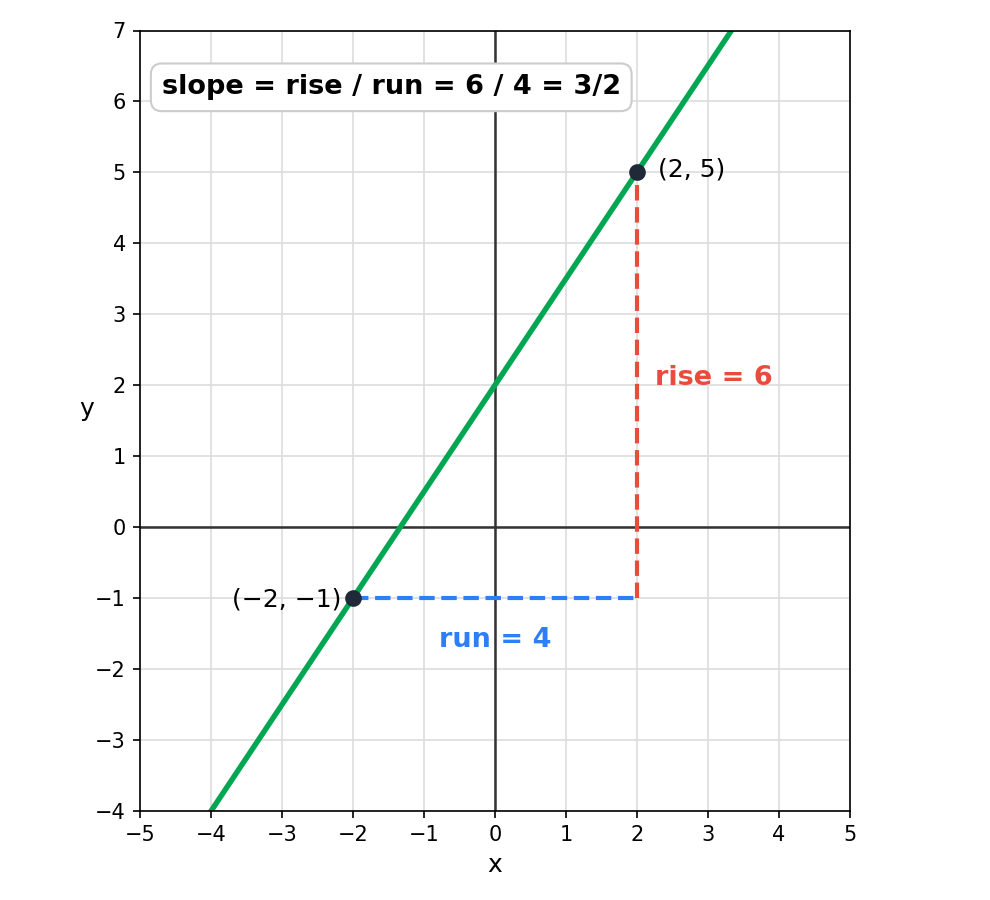
From \((-2, -1)\) to \((2, 5)\), you move 4 to the right and 6 up, so the slope is \(\tfrac{6}{4} = \tfrac{3}{2}\). A quick check: a line that goes up from left to right has a positive slope, and one that goes down has a negative slope.
If the equation is in slope-intercept form, \(y = mx + b\), the slope is the number in front of \(x\). In \(y = -4x + 7\), the slope is \(-4\).
If it is in standard form, like \(3x + 4y = 12\), solve for \(y\) first:
\[4y = -3x + 12 \;\Rightarrow\; y = -\tfrac{3}{4}x + 3\]
The slope is \(-\tfrac{3}{4}\). (There is a shortcut: for \(Ax + By = C\), the slope is \(-\tfrac{A}{B}\). Use it only if you remember the minus sign.)
In a table, slope is how much \(y\) changes each time \(x\) changes. In a word problem, slope is the rate: dollars per hour, miles per gallon, degrees per minute.
| Hours worked | Total cost ($) |
|---|---|
| 0 | 12 |
| 3 | 33 |
| 6 | 54 |
Every 3 hours, the cost goes up $21, so the slope is \(\tfrac{21}{3} = 7\) dollars per hour. The starting value, $12 at 0 hours, is the \(y\)-intercept, not the slope.
| Line | Slope | Why |
|---|---|---|
| Horizontal, like \(y = 4\) | 0 | No rise at all |
| Vertical, like \(x = 3\) | Undefined | The run is 0, and you can't divide by 0 |
| Parallel lines | Equal slopes | They rise at the same rate and never meet |
| Perpendicular lines | Negative reciprocals, like \(2\) and \(-\tfrac{1}{2}\) | Their slopes multiply to \(-1\) |
Slope appears on the ACCUPLACER, the TSIA2, the GED, the HiSET, the SAT, and the ACT. These six questions cover the forms you will see most.
1.What is the slope of the line through \((-3, 4)\) and \((1, -8)\)?
Common trap: Writing \(1 - 3\) in the bottom instead of \(1 - (-3)\). Subtracting a negative means adding, so the run is 4, not \(-2\).
Answer: A (\(-3\))
2.What is the slope of the line \(4x - 2y = 10\)?
Solve for \(y\) to get slope-intercept form.
\[\begin{gathered}-2y = -4x + 10 \\ \Rightarrow\; y = 2x - 5\end{gathered}\]The coefficient of \(x\) is the slope: 2.
Common trap: Reading the slope straight from the equation as 4. The slope is the coefficient of \(x\) only after \(y\) is alone on one side.
Answer: C (2)
3.The table shows points on a line. What is its slope?
| \(x\) | 0 | 2 | 4 | 6 |
| \(y\) | 7 | 4 | 1 | \(-2\) |
Each time \(x\) goes up by 2, \(y\) goes down by 3.
\[m = \frac{-3}{2} = -\tfrac{3}{2}\]Common trap: Flipping the fraction to \(-\tfrac{2}{3}\). The change in \(y\) always goes on top. Answering 7 mixes up the slope with the \(y\)-intercept.
Answer: A (\(-\tfrac{3}{2}\))
4.A plumber charges $85 for a 1-hour job and $205 for a 4-hour job. If the price grows at a constant rate, how much does each extra hour cost?
The hourly rate is the slope between the points \((1, 85)\) and \((4, 205)\).
\[m = \frac{205 - 85}{4 - 1} = \frac{120}{3} = 40\]Common trap: Dividing the total by the hours, \(205 \div 4 = 51.25\). That mixes in the fixed fee. The rate of change compares the difference in cost to the difference in hours.
Answer: B ($40)
5.What is the slope of the line through \((3, 2)\) and \((3, -5)\)?
The \(x\)-values are the same, so the run is \(3 - 3 = 0\).
\[m = \frac{-5 - 2}{0}\]Division by zero is not defined. The line is vertical, and a vertical line has an undefined slope.
Common trap: Saying the slope is 0. A slope of 0 belongs to a horizontal line, where the rise is 0. A vertical line has a run of 0.
Answer: B (Undefined)
6.Line \(k\) is perpendicular to \(y = -\tfrac{2}{3}x + 1\). What is the slope of line \(k\)?
Perpendicular slopes are negative reciprocals: flip the fraction and change the sign.
\[\begin{gathered}-\tfrac{2}{3} \\ \Rightarrow\; \tfrac{3}{2}\end{gathered}\]Check: \(-\tfrac{2}{3} \times \tfrac{3}{2} = -1\).
Common trap: Doing only one of the two steps. Changing only the sign gives \(\tfrac{2}{3}\), and flipping only gives \(-\tfrac{3}{2}\). You need both.
Answer: D (\(\tfrac{3}{2}\))
Teacher's note: When you get a slope, say it out loud as a sentence before you move on: "for every 1 step to the right, the line goes down 3." If the sentence doesn't match the picture or the story in the problem, the sign or the fraction is upside down. That one sentence catches most of the mistakes listed above.
On the ACCUPLACER, slope is part of "linear applications and graphs" in both the QAS and AAF tests. On the TSIA2, it falls under algebraic and quantitative reasoning, often inside a money problem. On the GED, the slope formula is printed on the formula sheet, so the points come from reading the problem carefully, not from memory.

Be the first to comment.